Pinkfarbene Wildtomate
$2.50
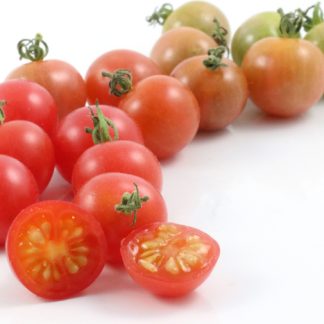
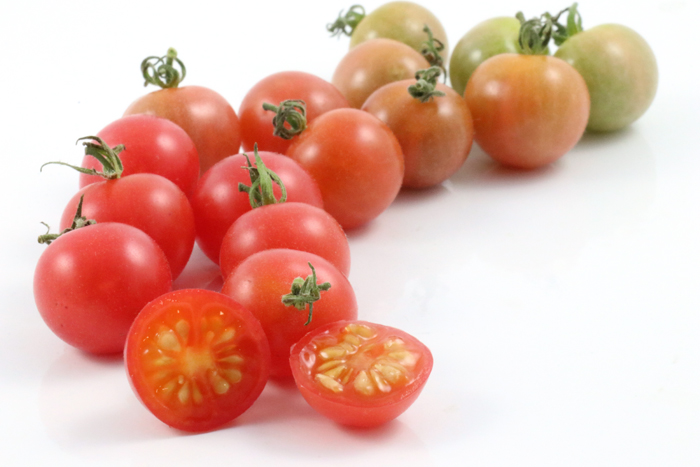
“Pinkfarbene Wildtomate,” or Pink Wild Tomato, is so similar to Ted’s Pink Currant that I am still not 100% certain that it is not the same variety. Pink currant-type tomatoes are rare to begin with, and my best efforts could not find its origin beyond being shared from the large archive of renowned seed collector Gerhard Bohl, who operated out of Germany and grew at least 3,000 varieties of tomatoes.
Is it possible that a clear epidermis tomato was found in undisturbed land without having already crossed with a “domestic” variety? But why does it matter if it is indeed a wild tomato versus a domesticated cross that has spread or self-sowed to locations other than directly in someone’s garden? It matters because I have seen this variety labeled as “S. pimpinellifolium” among various vendors. I believe this is incorrect for a number of reasons, among which two are rather easy to see: leaf form and length of the pistil relative to the stamens in the flowers.
If you are curious, you can check out the photo comparison of these traits in Figure 1 in this article: Takei, H., Shirasawa, K., Kuwabara, K., Toyoda, A., Matsuzawa, Y., Iioka, S., & Ariizumi, T. (2021). De novo genome assembly of two tomato ancestors, Solanum pimpinellifolium and Solanum lycopersicum var. cerasiforme, by long-read sequencing. DNA Research, 28(1), dsaa029. https://doi.org/10.1093/dnares/dsaa029
To me, the leaves and flowers more closely resemble Solanum lycopersicum var. cerasiforme. This makes sense if you believe, as some researchers do, that at least some accessions of S. l. cerasiforme have resulted from hybridization of S. pimpinellifolium and S. l. lycopersicum, while other accessions of S. l. cerasiforme are a direct ancestral or wild form originating in Mesoamerica.
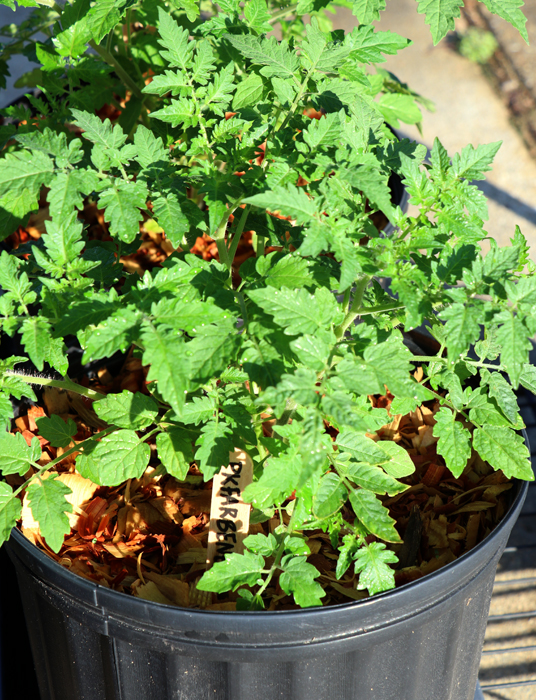
Pinkfarbene Wildtomate seemed to taste sweeter to me than Ted’s Wild Cherry; however, this could have been happenstance rather than a permanent trait. I have read that both of these varieties produce plants that can grow very large, even taller than 6 feet. I have always grown them in pots in order to control the size, for convenience. In my image here, this is Pinkfarbene Wildtomate in a three-gallon nursery pot. Both varieties still yielded plentiful fruits even with the smaller root space and plant size.
12 in stock